Across the United States, a growing number of state laws are curbing academic freedom within higher education. This alarming trend is causing widespread US university censorship, affecting nearly half of all college students. These regulations now dictate what topics professors can discuss in their classrooms, fundamentally altering the learning environment.
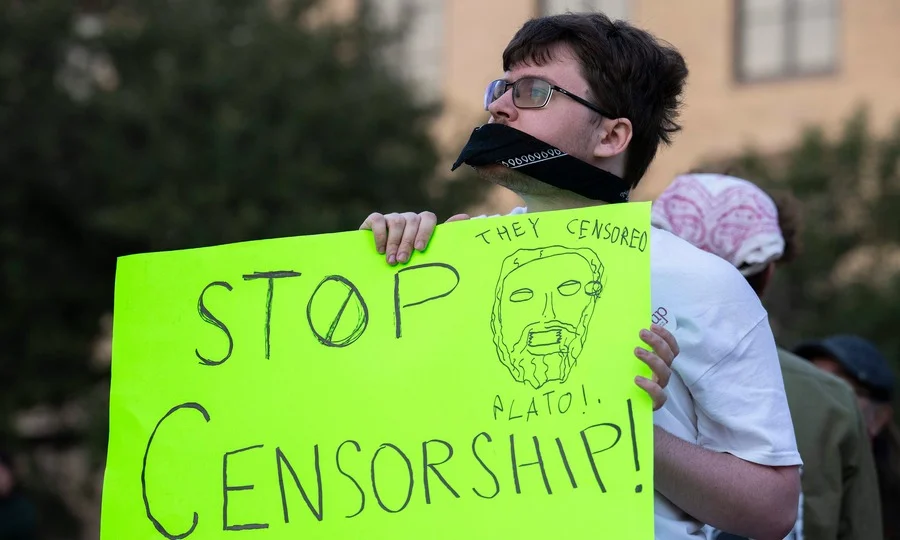
For instance, Dr. Martin Peterson, a philosophy professor at Texas A&M University, recently lost his position. He was instructed to remove Plato’s Symposium from his course syllabus due to its discussions of love and a third gender. University officials mandated the removal of all materials addressing race or gender, leading to his resignation.
Similarly, at the University of North Florida, education professor John W. White faced curriculum changes last year. Administrators asked him to delete terms like “diversity,” “equity,” and “inclusion” from his syllabus. They cited state regulations, emphasizing, “It’s the law, and we have to follow the law.”
This surge in legislation has fostered a climate of fear among faculty. Neal Hutchens, a professor at the University of Kentucky, describes a “chilling effect” on educators. Professors now worry about repercussions for their teaching, uncertain of institutional support if an incident gains public attention.
PEN America, a nonprofit advocating for free expression, has tracked this legislative spread since 2021. Their data shows nearly half of all students attend institutions in states with at least one law limiting classroom discussions. Topics like race, gender, and sexuality are increasingly treated as taboo, with Texas and Florida identified as particularly restrictive.
Laura Benitez of PEN America highlights the impact on students. “Students are in a climate of fear, where professors fear losing their jobs,” she states. This uncertainty prevents faculty from fully engaging in academic debates, hindering the learning process.
This wave of academic restriction emerged following a prior federal executive order. That order prohibited government agencies from training on “divisive concepts” related to race and sex. Although later rescinded federally, it spurred a powerful state-level movement.
Moreover, federal government agencies have recently pressured colleges to align with specific “priorities.” These demands link crucial funding and international student/faculty visas to compliance. The Department of Education, for example, outlined a series of demands for universities to maintain cooperation, including adopting specific definitions of sex.
An open letter from the Education Secretary also urged university presidents to address several areas of interest. These included merit-based admissions and “free speech.” Furthermore, increased fees for H-1B visas for foreign researchers and limits on international students’ stays were announced.
Florida promptly responded to federal guidance with a detailed document. It outlined existing state policies, such as bans on diversity statements, supporting these agendas. Restrictions on undocumented student enrollment are also planned for 2027 in Florida, home to the nation’s second-largest public university system.
University responses have varied significantly by state and political alignment. Institutions in Democrat-governed states have largely maintained broad academic freedom. Conversely, Republican-led states generally support federal higher-education priorities. Private universities show mixed reactions, with some engaging in legal battles and others seeking agreements to mitigate financial risks.
Professor Hutchens expressed surprise at the rapid adoption of these agendas within traditionally independent institutions. He reflected on the unexpected fragility of systems supporting academic freedom and free thought. He concluded that federal policies could harm university research productivity for years.